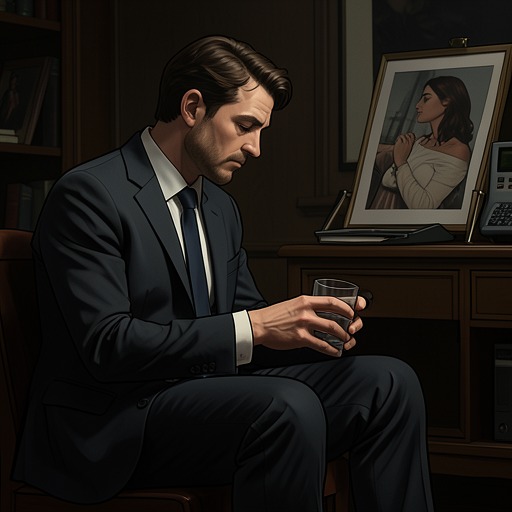
Shivam’s reconciliation with Aparna
CEO's Unexpected Love: A sweet office romance with a guaranteed HEAShivam’s reconciliation with Aparna is the emotional and structural turning point through which their damaged relationship becomes possible again. The scene does not erase the harm caused by his silence and mistaken assumptions; instead, it makes repair depend on confession, accountability, physical care, and a direct admission that love has survived the rupture.
Circumstances of the Rupture
The reconciliation follows a chain of misread signals intensified by older wounds. Shivam’s grief over Mohini Bhattacharya’s death has left him vulnerable to emotional substitution: Aparna’s silver jhumkas remind him of the woman he lost, and memories of Mohini’s laughter, walks, and the sense of completeness she once gave him overwhelm him. His bereavement does not merely remain in the past; it shapes how he interprets Aparna in the present and helps explain why attraction and fear become entangled.
At the same time, Shivam is drawn into Sherlie D Costa’s suicidal mental-health crisis. After returning from Delhi to Mumbai because Alex D Costa told him that Sherlie had tried to slit her wrists again, Shivam sees her sedated in a hospital bed and feels responsible for the growth of her obsession. When Aparna later sees Shivam and Sherlie being congratulated by colleagues, Sherlie appears weak but happy while Shivam wears an artificial smile. The public scene conceals the private emergency behind it, allowing Aparna to interpret the announced engagement as a genuine romantic choice rather than a desperate attempt to keep Sherlie alive.
The misunderstanding deepens because Shivam does not confront Aparna. After Aparna saves his life by exposing Alex D Costa and Sherlie, Shivam leaves in a daze, consumed by regret over his earlier rudeness and by the knowledge that her wedding seems to be the following day. He has mistaken Aparna’s Arangetram invitation for a wedding invitation, reading the image of her in Bharatanatyam costume and the name of Rahul Ramachandran as evidence that she has chosen another man. The error is not a minor detail: it transforms his fear of losing her into a self-destructive decision to retreat from her.
The Backstage Attempt at Repair
Shivam first begins the repair during Aparna’s Bharatanatyam Arangetram. He reaches backstage while she is taking a brief rest, intending to tell her that he is proud of her, thank her for saving him, and apologise for his behaviour, but the sight of her pain makes his prepared words fall silent. Their physical distance becomes charged: Aparna looks away as she does when she is angry or hurt, while Shivam reaches for both her hands and tries to cross the emotional distance he created.
Instead of offering a formal explanation immediately, Shivam uses the performance itself as a bridge. Referring to the composition Priye Charusheele, he jokingly asks Aparna to connect him with its composer. When she points out that the poet Jayadeva lived in the eleventh century, Shivam turns the failed request into a confession. He says he would have wanted Jayadeva’s help composing something longer to pacify the woman who loved him, whom he hurt through both naivete and rudeness, and whom he wants back in his life. The playful exchange therefore carries a serious subtext: he cannot yet make a perfectly composed declaration, but he is trying to make his remorse unmistakable.
Aparna’s reaction shows the force of the encounter before the dispute has been fully discussed. Her lips quiver and her eyes fill with tears, while Shivam notices the risk that her stage makeup will be ruined. He calls her precious, cautions her not to cry, catches a tear from her kohl-smeared lashes, and kisses the droplet. The gesture is intimate but also attentive to the immediate circumstances of her performance. He recognises that he has come at the wrong moment, tells her that pride in what he saw prevented him from staying away, wishes her well for the rest of the evening, and promises to remain until the end, including the Parvati Lasya sequence.
The Full Explanation
The decisive conversation occurs after Shivam reaches Aparna’s flat when she is alone, pale, feverish, and in severe pain. She manages to reach the door but can barely keep her balance; when it opens, she falls into his arms sobbing. Shivam closes the door, catches her, reassures her that he is there, and realises that she is burning with fever. This physical crisis creates the conditions for emotional honesty. Care is no longer an abstract promise: he must first support her body before he can ask her to trust his words.
They speak at once and then pause, each waiting for the other to continue. Shivam explains that he had gone to Delhi with his mother to help his brother with a bureaucratic problem when Alex D Costa called about Sherlie’s renewed suicide attempt. He says that he intended to make Sherlie face reality, but also wanted to ask Aparna’s consent before announcing that he and Aparna were together and proposing an engagement to her.
His account then identifies the precise point at which his reasoning failed. He had found Aparna discussing venues, menus, and invitations with Shija Meity while apparently enthusiastic about Rahul Ramachandran. Because he did not ask what the arrangements concerned, he concluded that Aparna had moved on and was preparing to marry Rahul. The Arangetram card, whose title identifies it as the “Arangetram of Kum Aparna Mahadevan,” later exposes the error. Shivam’s discovery is a recognition scene in which the supposed wedding becomes a dance debut and the rival becomes the singer for her performance.
Shivam does not defend the conclusion as reasonable. He admits that he was an idiot who allowed an emotional misunderstanding to overpower the bond between them. He explains that he believed Aparna had left him without speaking to him, while Sherlie, despite her suffocating hold over his life, seemed capable of dying for him. Feeling unable to be enough for Aparna and believing that Sherlie’s life might depend on him, he told Sherlie that he would be there for her all his life; Sherlie then announced an engagement. The explanation reveals the tragic mechanism of the rupture: a crisis requiring boundaries becomes a promise made under pressure, while romantic insecurity prevents Shivam from testing his assumptions with the person he actually loves.
Apology and Forgiveness
Aparna names the central failure directly: Shivam should have confronted her once, even once. His silence is therefore treated as an active cause of the damage, not as an unavoidable consequence of circumstance. Shivam responds by lowering his gaze and caressing her palms before holding them tightly. The gesture accompanies a verbal admission that his temperament and impulsiveness have made him capable of managing a company while mishandling the most important relationship in his life.
His apology is unusually explicit. Shivam says he is sorry for the pain he caused, for doubting Aparna, and for acting on unfounded conclusions. He acknowledges that he should have trusted their bond rather than allowing emotion to govern his actions. He also credits Aparna with saving his life by exposing Alex D Costa and Sherlie, then states that he wants her and cannot be himself if he loses her. The apology therefore joins moral accountability to romantic dependence: he accepts blame while making clear that the relationship is not merely desirable but central to his sense of self.
Aparna forgives him without extending the punishment. She pulls him into a hug, and when he asks whether she has forgiven him so quickly, she answers that there is no point in prolonging the matter because she loves him as much as he loves her and finds no pleasure in making him grovel. Her forgiveness is not presented as indifference to the hurt; it is an active decision to stop the conflict from becoming another form of distance. She admits that she cannot play hard with him because she loves him, while Shivam recognises that she has again said what he had been struggling to express.
Significance and Outcome
The reconciliation resolves the mistaken-engagement plot by replacing public performance with private truth. At work, colleagues congratulate Shivam and Sherlie while Shivam wears an artificial smile; backstage, he uses wit and touch to approach Aparna; at her flat, fever, tears, and joined hands strip away the social masks. The movement from office spectacle to performance space to domestic emergency gives the reconciliation a clear progression from concealment toward disclosure.
The scene also reverses the emotional value of several recurring motifs. Aparna’s jhumkas initially trigger Shivam’s grief for Mohini, but his renewed attention to Aparna finally distinguishes her from the woman he lost. The Arangetram invitation first becomes proof of abandonment, then becomes the evidence that corrects his jealousy. Sherlie’s announced engagement, initially experienced as a binding obligation, is exposed as the consequence of an unexamined emergency and a promise made without confronting Aparna. Against these distortions, the final exchange restores direct naming: Aparna and Shivam speak each other’s names, explain what happened, apologise, and say that they love one another.
The ending is therefore a second-chance resolution rather than a simple return to the earlier romance. Shivam must pass through grief, guilt, mistaken inference, and the consequences of failing to communicate before he can ask for Aparna back. Aparna’s care for him has already become life-saving action, while her forgiveness gives that action a relational future. Their embrace does not undo the crisis, but it establishes a renewed promise: Shivam must not repeat the silence and impulsive judgment that nearly destroyed their bond.